Two mothers in Baidoa on treating a child for severe acute malnutrition
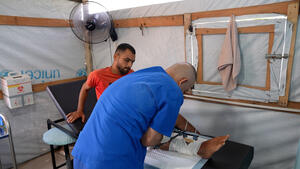
At the inpatient treatment centre at Bay Regional Hospital in Baidoa, children arrive weak, feverish and unable to feed. Their mothers arrive having walked for hours, or having made the same journey three times in a single year.
Nasteho Ibrahim and Nuriyo Mo'alin both have a child admitted for severe acute malnutrition. Their accounts describe what it takes to keep a child alive here: households with no income to fall back on, water that has not come since the Jilaal dry season, a first harvest in years lost to a child's illness, and newborns given sweetened tea because there is no milk.
What they describe matches what MSF teams are seeing across Southwest State, where malnutrition admissions have more than doubled in a year. Neither woman has had sustained support from any aid organisation. One has never received any. The other received $180, once, three years ago.
Testimony 01
"One twin didn't survive. The other is still fighting."
Nasteho Ibrahim has already buried one of her twins. Her second child is now admitted to the inpatient treatment centre at Bay Regional Hospital in Baidoa, being treated for severe acute malnutrition.
"It is an illness that affected all of my six children; there isn't one among them that I haven't had to admit to the hospital like this."
This is the third time Nasteho has brought her son Ahmed to this hospital during his short life. He was too weak to feed, feverish, with diarrhoea and difficulty breathing. He recovered after six days of treatment, then relapsed within days of going home.
"Yesterday and the day before, he started vomiting and having diarrhoea again. After that, he began struggling to breathe again and stopped nursing," Nasteho says.
His skin shows a toll of malnutrition, too.
"My child cries continuously like this because he has a lesion, to the extent that he can't even be held up, and I have no breast milk for him."
Nasteho cannot produce enough milk to feed him as she struggles with malnutrition herself. "My breasts have no milk right now," she says.
"When he is given this milk provided by the hospital, my son recovers. Last time, he was given it, and I took him home from here in good health. My breast milk does not help at all."
Her son's illness sits on top of a household with nothing left to fall back on. She lost her job as a school cook when the school closed, and the family now survives on whatever food neighbours and relatives can spare.
"I give them whatever food we can get or whatever we receive from our neighbours, because my husband doesn't have a job. No organisation has ever supported me. We are looking for an organisation to help us, and we are constantly searching, but we have not received any help yet," she says.
"We are facing a water shortage and haven't had water since the dry season, the Jilaal. Except for occasionally fetching a jerrycan of water from neighbours or nearby households, we haven't seen anyone even give us water. We need food and water; that is all we are lacking."
Nasteho is not displaced. She has lived in Baidoa for years, which says something about how far this crisis reaches beyond the displacement camps. Her son's repeated admissions match what MSF teams are seeing across Southwest State, where malnutrition admissions have more than doubled in a year.
Testimony 02
"We do not have nutritious food to give to the children."
Nuriyo Mo'alin walked for hours to get her daughter to the hospital. Seven days into treatment for severe acute malnutrition and its complications, the girl is starting to recover.
"My daughter is sick; she is suffering from continuous diarrhoea and vomiting. And now, she has also developed anaemia. They couldn't find a vein in her limbs, so the IV line was inserted into her scalp," Nuriyo says.
Nuriyo is a farmer. This year brought a rare chance to plant, after years of failed rains, and her daughter's illness took that chance away.
"Something could have grown in the fields after the rain came, but just when it was time to cultivate, my daughter fell ill, and nothing was planted."
"There has been a drought over the past few years, and we couldn't benefit from this rain either, because my daughter fell sick. We gather firewood and bring it to Baidoa. That is the only way we look for a livelihood," Nuriyo says.
Feeding her children has never been enough. "I have given birth to seven children, and this one I am breastfeeding is my youngest," she says. Her breast milk alone has never sustained them.
"Breast milk alone is never enough for my children; I have been giving them tea since the very day they were born."
Newborns get sweetened tea in place of milk within hours of birth. "If a baby is born tonight, sweet tea with sugar is brewed for them in the morning; it is left to cool down, and then it is given to them. Vegetables are completely unavailable in our area. Even if you just need a single onion, your only option is to beg someone who bought it from the city; otherwise, there is no way to get it," she says.
Families with nothing cook sorghum, if they have it. "A person who has nothing just cooks sorghum; if they don't even have that, they simply go hungry. We only get two meals a day, in the morning and at night. And even then, it is rare that we are able to get those two meals."
Organised support has been almost nonexistent. "There is no organisation helping us," Nuriyo says.
"An organisation gave us some assistance. They gave us $180 for two months, but that was three years ago."
"We suffered from a severe water shortage over the past few months; even the donkeys we used to fetch water with, died from the drought," she says.
This is the first time in her life Nuriyo has brought a child to a hospital. Her community is that far from medical care, and that far outside the reach of the humanitarian response. "People usually go to Baidoa, eight kilometres away, to seek help and resources, but we haven't even gone there to look for anything," she says.
Nuriyo has been through severe acute malnutrition herself. "I was severely malnourished back then. They treated me while I was pregnant, and then I simply returned to the countryside," she recalls. Treated once, then left without any follow-up, and now her daughter is going through the same thing.
What these accounts have in common
Across both testimonies, the same conditions recur:
- Children admitted more than once, recovering on therapeutic milk and relapsing within days of going home.
- Mothers who are malnourished themselves and unable to breastfeed, with sweetened tea substituted for milk from the first day of life.
- No safe water since the Jilaal dry season, and livestock lost to drought.
- Households with no income: a school cook out of work, a farmer who missed the first plantable season in years.
- No sustained assistance from any aid organisation, and communities several kilometres from the nearest medical care.
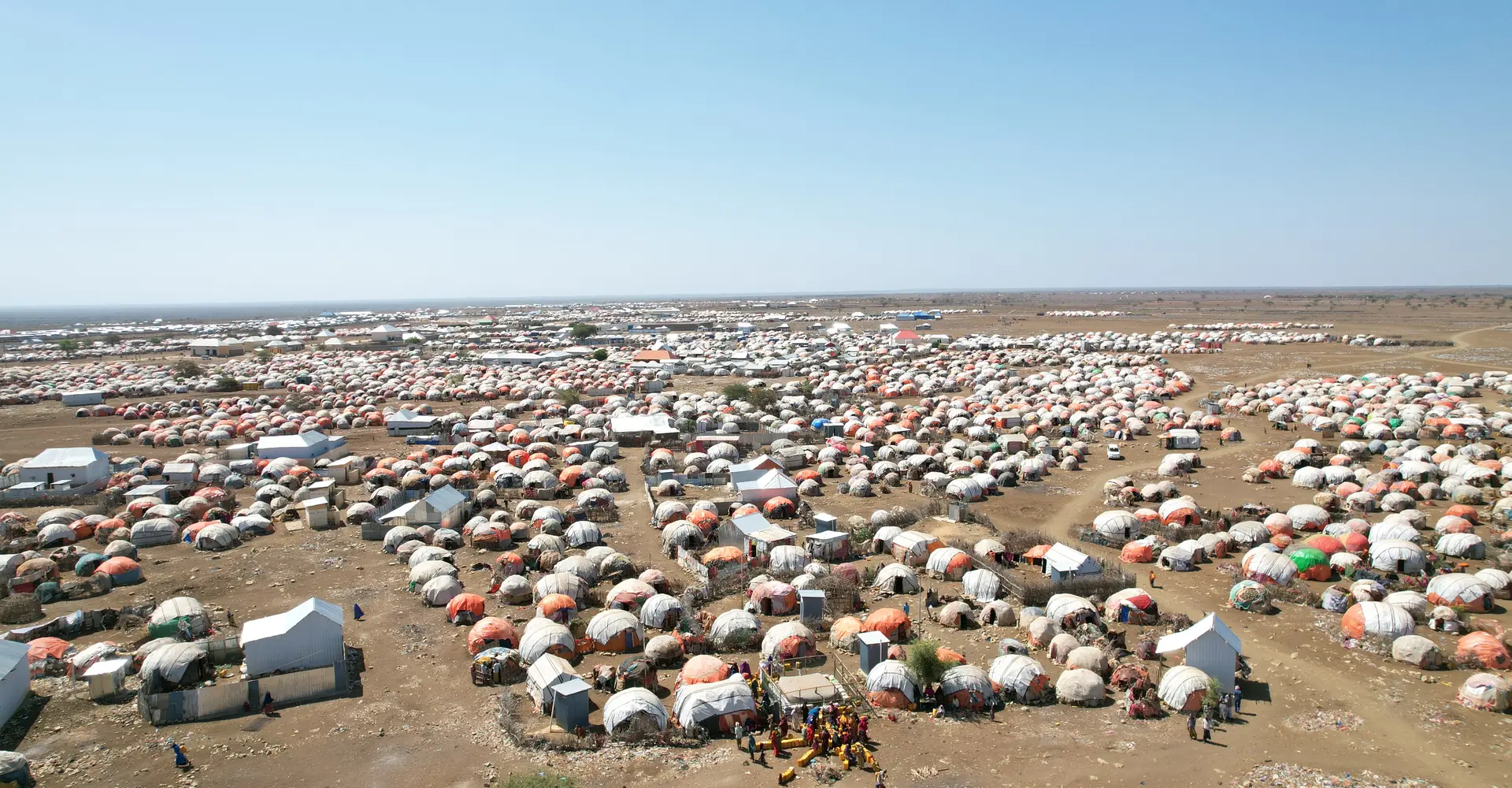
Neither family lives in a displacement camp. Nasteho has lived in Baidoa for years, and Nuriyo's village sits eight kilometres outside it. Both fall outside the reach of the current humanitarian response, in a region where MSF malnutrition admissions have more than doubled in a year.
Editor's note
These testimonies were recorded in Baidoa, Southwest State, and translated from Somali. Quotes have been lightly edited for length and clarity.