Bekaa: Where lives have been upheaved in the shadow of war
Lebanon · Feature
In eastern Lebanon, families displaced by war are rebuilding with no income and often no health coverage, in a governorate where public attention has largely moved on.
Bekaa, Lebanon · 18 August 2026
Beyond the devastation in southern Lebanon and Beirut’s southern suburbs, the war’s consequences have also reached the Bekaa Valley, a vast agricultural region in eastern Lebanon bordering Syria. This adds yet another layer to the overlapping crises the region has endured, including economic collapse, underfunded healthcare facilities, inadequate water and sanitation infrastructure, and a protracted refugee situation.
Since Israeli bombardment escalated on 2 March, people fleeing blanket evacuation orders have sought refuge across the Bekaa, where already vulnerable communities, including Syrian refugees, face mounting pressure. Displacement in the governorate peaked in April, with 52,935 people recorded as displaced in shelters and within host communities. Today, many of the families returning to their homes and neighborhoods within Bekaa are facing facilities damaged by Israeli bombardment and different barriers to accessing healthcare.
Many have settled in the Bekaa, renting what they can afford, staying in collective shelters, or returning to family homes left years earlier. For them, displacement didn’t end when the bombardment became less intense; it became the slower work of rebuilding with no income and often no health coverage, in a governorate where public attention has largely moved on.
Displaced, Without Stability
In Kamed El Loz, in Lebanon’s West Bekaa, the landscape opens into farmland and wide valley views, but for families like Maha and Hassan, finding a place to live does not mean finding stability. In a rented room, Maha cares for her husband, Hassan, since March, when the war forced them out of Al Khiyam, southern Lebanon, where their house was destroyed. Hassan cannot move independently; Maha is his only caregiver. Staying at her sister’s second-floor apartment proved unworkable, so they moved to Kamed El Loz, with no income and no immediate prospect of returning home.
“Since we left our home, everything has become more difficult. I must take care of my husband and manage everything on my own.”
Maha, displaced from Al Khiyam, southern Lebanon
Maha had stopped taking the medication she needs as she could no longer afford it.
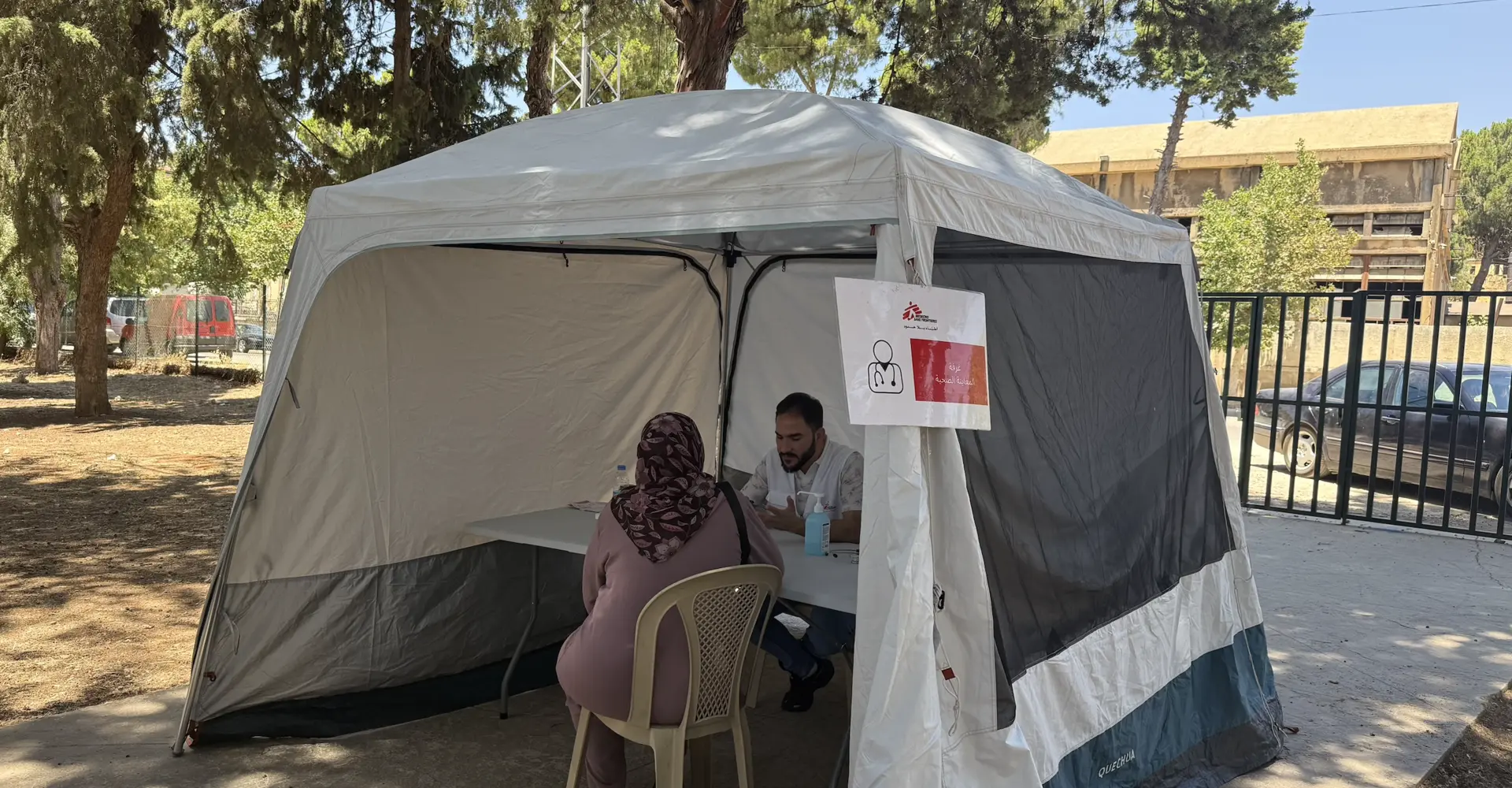
Through outreach visits, MSF teams met Hassan and Maha, and helped them access the healthcare services they need.
MSF medical activities in the Bekaa
- 13,722medical consultations provided by MSF teams in the Bekaa
- 7,505consultations for acute conditions
- 6,760consultations for non-communicable diseases
- 2,570sexual and reproductive health interventions
- 852consultations for children under five
- 3,270health promotion sessions
Figures since 2 March 2026.
In Zahle, Bekaa governorate, another family faces a different upheaval, as they prepared to welcome a new member of the family. Before the war, the family was living in Nabatiyeh, southern Lebanon, building a life around agriculture. Khalil and his pregnant wife, Mirna, returned to his hometown, Zahle, into an old family house inherited from his grandfather; shelter, but not stability. With Mirna close to giving birth, the family had no way to cover the cost.
“Our work is gone, and our lives are torn.”
Khalil, displaced from Nabatiyeh, southern Lebanon
The consequences of the war have affected families like Mirna and Khalil far beyond their homes, disrupting their income, housing, and ability to prepare for the birth of their child.
“When you are preparing for your child to be born, you should think about the future. Instead, I was worried about how we would pay for the delivery and how we would rebuild our lives.”
Khalil
Through its partnership with Libano-Français Hospital in Zahle, MSF helped ensure Mirna could access the hospital’s specialized maternity care and give birth safely.
What Access to Healthcare Means
“The Lebanese population is enduring difficult living conditions due to the protracted economic crisis exacerbated by the ongoing armed conflict and political instability. Internally displaced people, refugees, and less privileged communities are among those most affected, often facing overcrowded living conditions, limited access to healthcare, and growing difficulties affording food and shelter. Civilians must be protected, and safe, timely access to humanitarian assistance and healthcare must be ensured for everyone in need.”
Amro Ibrahim, MSF Bekaa project coordinator
MSF has maintained a long-term medical presence in the Bekaa, adapting its response as needs change. In Baalbek-Hermel, MSF operates an essential healthcare center in Hermel and a mobile clinic, while across the Bekaa, mobile teams continue to reach communities where access to healthcare is limited.
Since the escalation of Israeli bombardment on 2 March, MSF has also supported people displaced into the Bekaa, including those living in collective shelters and public spaces. Teams provided essential relief items, rehabilitated water and sanitation systems, supplied fuel and water, and delivered healthcare through mobile clinics.
Relief items and water distributed in the Bekaa
- 1,796hygiene kits
- 1,020blankets
- 962mattresses
- 109,691liters of drinking water
- 929,000liters of water
- 31,200liters of fuel
- 32cleaning kits
Figures since 2 March 2026.
“In a context where people face multiple barriers to healthcare, access is not simply about having a service available. Partnering with an existing operational hospital allowed us to respond rapidly to those needs and provide safe access.”
Loubna Marouf, MSF emergency coordinator in Bekaa
MSF’s team also supports access to emergency obstetrics care at secondary health facilities in the Bekaa, strengthening hospital capacity and supporting the provision of quality, timely care to communities.
Bridging Gaps
For those who were displaced, those returning home, and those who stayed, the crisis continues to shape daily life; through lost livelihoods, damaged homes, and pressure on essential services.
MSF’s response has therefore evolved alongside these changing needs: from emergency support during displacement to longer-term healthcare activities, mobile clinics, hospital support, essential healthcare and referrals for specialized treatment.
The crisis may have moved out of the headlines, but for many in the Bekaa, its effects still shape everyday life. Maintaining access to healthcare means continuing to reach communities where they are, supporting health facilities under pressure, and ensuring that communities can receive the care they need.
The Needs That Remain
Across the Bekaa, Lebanese communities, Syrian refugees, internally displaced people and returnees continue to face the consequences of overlapping crises. For many, immediate danger may no longer be the only concern. Rebuilding a home, recovering income, and accessing healthcare can become a longer struggle.
In Bekaa, the effects of crises continue to shape where people live, how they earn a living, and whether they can access the care they need.
“I don’t feel stable, and I don’t think I will ever feel that stability again because my home is gone. I only feel at ease in my own home, in my own village.”
Maha, Kamed El Loz, West Bekaa
Displacement figure for the Bekaa governorate (52,935 people, April 2026) and all MSF activity figures cover the period since 2 March 2026. MSF maintains a long-term medical presence in the Bekaa, operating an essential healthcare center and a mobile clinic in Hermel, Baalbek-Hermel, running mobile teams across the governorate, and supporting maternity and emergency obstetric care through a partnership with Libano-Français Hospital in Zahle.