A Brush with Memory: Between Home and Displacement
MSF Lebanon
A Brush with Memory: Between Home and Displacement
A collaboration between Médecins Sans Frontières (MSF) Lebanon and artist Aya Debes. Five families, photographed where displacement left them, then drawn back into the homes they carry in their heads.
The situation
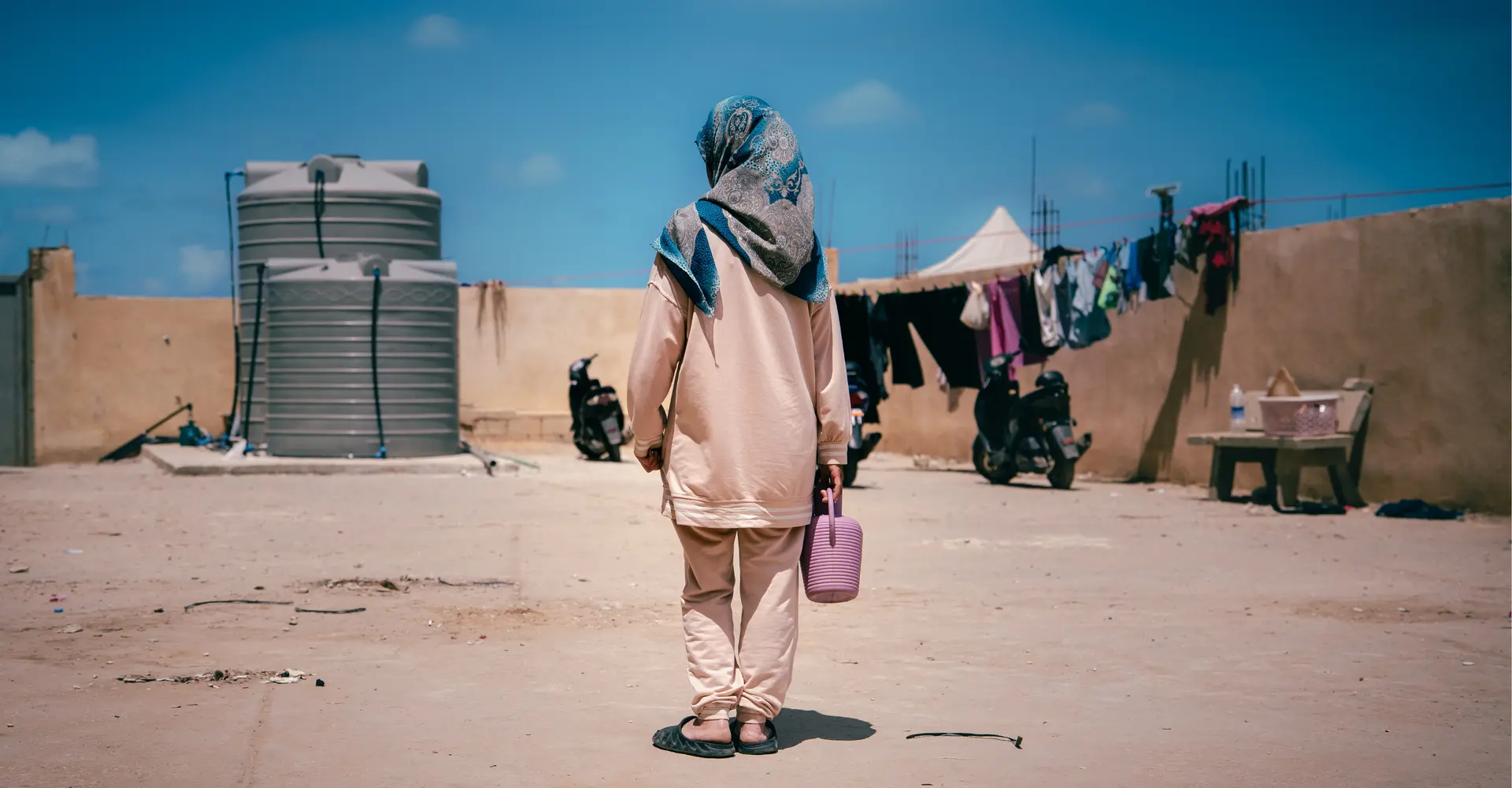
At its peak, the Israeli war displaced more than one million people in Lebanon. As of July 22, more than 375,000* of them remain unable to return home, or simply no longer have homes to return to.
Forcibly displaced people endure the ongoing toll of war and displacement, which extends far beyond the loss of a home and stability.
*According to the International Organization for Migration (IOM).
1 million+
Forcibly displaced at the war's peak
375,000+
Still unable to return, as of 22 July
01
Halime
From Qaaqaaiyet El Jisr, Nabatiyeh
“I just want to reach home and kiss the doorstep.”
Halime was displaced with her husband and daughter from Qaaqaaiyet El Jisr in Nabatiyeh to a public school in Beirut. Displacement has weighed heavily on her both physically and psychologically. She says: “Everything here is hard for me. I can’t accept it. I’ve developed so much stress that I can no longer stand on my feet or walk. If I want to get up off the floor, my husband has to pull me up. I went to the doctor and ran tests, and it turned out I have inflammation throughout my entire body.”
Halime was born and raised in Beirut, and she doesn’t deny her preference for city life. Yet, she deeply longs for her modest house in the village, with its small garden that her husband plants and tends to. Halime was home-loving and rarely left her house unless necessary, but she was warmly hospitable, welcoming visitors at all hours of the day.
With the outbreak of the latest escalation of the Israeli war, Halime was forced to leave her home alongside her husband and 13-year-old daughter. Displacement took a heavy toll on Halime, exhausting her body until she was no longer able to stand or walk without help. It also drove her daughter into fear and isolation, especially given the harsh conditions at the public school serving as their shelter in Beirut. Halime closes her eyes and finds herself back on her balcony, which she had transformed into a cozy, tent-like room with wooden windows where family and friends gathered, summer and winter alike.
Video testimonial
“My whole life in this house has been beautiful.”
“When my daughter came to the public school here, her initial reaction was that she didn’t want to live here. But reality set in: Darling, there is no home. Right now, there’s only this school to be our shelter. You have to accept it.”
02
Warde*
From Deir Al Zahrani, Nabatiyeh
“Every flower has a story and a name, and I care for them like my own children.”
Warde couldn’t hold back her laughter as she told us that, when she first left her home following the latest escalation of the Israeli war in Lebanon, she took blankets and pillows with her to guarantee a minimum of comfort for her family: her husband, three daughters, and a son. The family remained in their southern home for 18 days amidst the roar of Israeli warplanes and missiles, until an airstrike struck directly behind the house, leaving people dead and injured.
Warde spoke of her children’s suffering during displacement: their disrupted education, a feeling of hopelessness away from their home and village, the financial hardship, and the loss of their livelihoods, especially since this was the second time the family was displaced during this war. They sought refuge at a shelter in Jiyeh, Mount Lebanon. The Israeli strikes shattered the windowpanes in Warde’s home in Deir Al Zahrani, but she refuses to replace the broken glass in one of the windows because it reminds her of a neighbour who used to pass by their house every day before he was killed in the war.
Warde deeply misses her garden, filled with the scents of roses, Brugmansia, and bitter orange blossoms, and she longs to return home to plant the flowers she bought and cared for during her displacement. Warde remains displaced in Jiyeh, far from her village.
*Name changed.
Video testimonial
“She left her garden behind. Now she waters what’s left.”
“A small slope, starting from below with a big chinaberry tree. You go up a little, there is a loquat tree with big, delicious fruit that we’re always climbing... A small, cozy home: two rooms, a kitchen, and a bathroom, and I was so happy with it.”
03
Nisrine
From Seddiqine, Sour / Tyre
“I brought all my memories with me; even my home is in my mind and imagination. I feel like it’s right here with me.”
Nisrine lived in her home with her husband and mother. She and her mother used to make their household mouneh (preserved seasonal foods) together, from kishk and za’atar to oil-cured aubergines, olives, and jams. Nisrine devotedly cared for her mother until she passed away.
She still recalls the horrors of the 2024 escalation of Israeli war in Lebanon, when she and her husband were forced to flee their home on a motorcycle in the early hours of the morning, spending nearly 37 hours on the road before reaching a shelter in Hamra, Beirut. Just ten days before the latest escalation of war, Nisrine had bought new glassware and kitchen supplies, but she was forcibly displaced before getting the chance to use them.
Even in displacement, Nisrine brought her mouneh from home and set aside a special spot for it in the school-turned-shelter in Jiyeh, Mount Lebanon: a piece of home and a symbol of hope for return. Several weeks ago, Nisrine returned to her village following the de-escalation in the south, but she is still unable to return to her home.
Video testimonial
“I’ve even brought my home with me.”
“I miss everything about my house. Everything, everything, everything. During the truce, we went up and thought it was over. But when I went to the house and saw the destruction, I realised that it was going to be a long process.”
04
Mohamad Ali* & Walaa*
From Mayfadoun, Nabatiyeh
In their own words
“If there’s anything we’ll hold on to from our displacement, it’s the good people we’ve met.”
Mohamad Ali
Mohamad Ali*, a Syrian from Mount Hermon, married Walaa*, a Lebanese woman from the south. They lived in Syria for a few years, where their daughter was born, before moving to southern Lebanon in 2011, where they had their son. In Mayfadoun, the family lived in a traditional heritage home with a courtyard featuring a grapevine, two pomegranate trees, a flower bed, and a small plot where Mohamad Ali grew vegetables and herbs. The family used to gather under the shade of the grapevine to share dinner seated on the ground, while Walaa took joy in cooking various dishes and sweets.
During the latest escalation of the Israeli war, Walaa lost her unborn baby due to the terror caused by sonic booms from low-flying Israeli warplanes, while her 16-year-old daughter lost her friend. At the shelter in Jiyeh, Mount Lebanon, they face severe daily hardships, from a lack of basic appliances like refrigerators to deteriorating water and sanitation conditions, including a shortage of toilets and a lack of privacy. Despite the pain, Mohamad Ali and Walaa hold onto hope that they will return to their home and reunite with the neighbours who were also displaced.
*Names changed.
“The sound of the warplanes was so frightening. No matter how much faith one has in God, fear is out of your hands.”
05
Said & Sanaa
From Hariss, Nabatiyeh
In their own words
“They deprived us of so many things that were dear to us. And now we won’t find a place to settle in. We’ve just gone from one displacement to another.”
Said
During the latest escalation of the Israeli war in Lebanon in March 2026, an Israeli airstrike destroyed a building owned by Said and Sanaa’s family. The couple lost their home, which had previously survived prior rounds of Israeli escalation. The family was displaced to Safa Stadium in Beirut, where they all endure immense psychological strain due to severe overcrowding and poor water and sanitation conditions, on top of Said’s lung issues, diabetes, and hypertension.
Sanaa shared her grief upon seeing photos of her home turned to rubble, so thoroughly destroyed that searching through the debris for anything to salvage is impossible. Yet, she finds comfort in knowing that her children are safe. For Said, the pain lies in the loss of his family heirlooms, including an antique lantern and traditional harvesting tools that are irreplaceable today. Said and Sanaa’s daughter, displaced alongside them, tries to preserve the traditions she grew up with, like gathering family together during happy occasions, even amid their current reality and complete uncertainty.
“When will I get back to my couch, to sitting in the kitchen with my cup of coffee beside me? My heart breaks to the idea that we might not find that again anytime soon. God willing we stay alive until the house is rebuilt and I can relive these moments. It’s a deep ache, a deep ache.”